



At the heart of NEPTUNE is a choice between two high-quality MEMS accelerometers:
- a new 150 dB or 170 dB MEMS generation for applications demanding the widest possible dynamic range
- or a 90 dB option where cost efficiency is a priority without sacrificing reliability.
A Gigabit Ethernet port with PoE support means a single cable handles both data and power. Built-in Wi-Fi and an optional 4G or 5G modem ensure the instrument stays connected even in remote or infrastructure-poor locations. Local data storage on a Micro SD card based on ring buffer architecture, provides an additional layer of redundancy.
EXCELLENT PERFORMANCE
The sample rate is adjustable up to 4000 sps per channel (depending on sensor choice). The internal memory is up to 512 GByte.
The data format is MiniSEED.
Using trigger criteria available in the firmware, it is possible to distinguish environmental vibrations from true seismic events.
The built-in GNSS receiver synchronizes the system clock with the absolute time so a network of several units where all channels are synchronized can be created.
EASY TO USE
You can control NEPTUNE-accelerograph locally via network connection (LAN or WiFi), and remotely using the optionally integrated LTE modem.
The instrument can be used as a “stand-alone” unit to record seismic events in the field or it can be used in a MASTER-SLAVE based monitoring network where multiple instruments are connected to each other; the MASTER device manages the interconnection with the other SLAVE units, collecting data coming from them and managing connection with the remote server. Furthermore, MASTER and SLAVE units can perform periodic analysis of the ambient noise and post-seismic vibrations in order to evaluate the structural damage caused by an earthquake, in real-time.
Thanks to SeedLink protocol, NEPTUNE is compatible with most popular seismic analysis software (Seiscomp3, Antelope, Earthworm).
INTEGRATED UPS
NEPTUNE accepts, from an M8 connector, a wide DC input range of 9–36V, making it fully compatible with battery packs and solar systems for offgrid installations. Two USB-C ports round out the interface: one for direct CPU console access, one for fast data offload via pen drive. The Micro SD and SIM card slots are both sealed behind IP67-rated lids, ensuring NEPTUNE holds up in demanding field conditions.
NEPTUNE is internally battery backed for 24 hours. For large-scale monitoring campaigns, NEPTUNE offers multiple synchronization methods. Each unit can lock independently to GNSS time, or the entire network can be synchronized over Ethernet using the Precision Time Protocol (PTP). In the latter configuration, a single NEPTUNE, connected to a GNSS antenna, acts as the grandmaster clock, distributing timing to all other units across the network with a synchronization accuracy of under one microsecond. This makes NEPTUNE an ideal platform for dense sensor arrays where precise time-alignment between measurement points is critical.
 In this operational mode, NEPTUNE acquires data as a simple recorder. The data is then either stored on its built-in memory or made available via a MiniSeed stream.
 In this operational mode NEPTUNE can be connected to other Lunitek devices (Triton, Atlas), via LAN or WIFI and the whole system will act as one multichannel sensor.
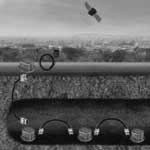 A Daisy Chain connection is intended for applications where multiple devices are installed in-line when guaranteeing sufficient sky-view for GNSS is difficult and there is no local power supply.