

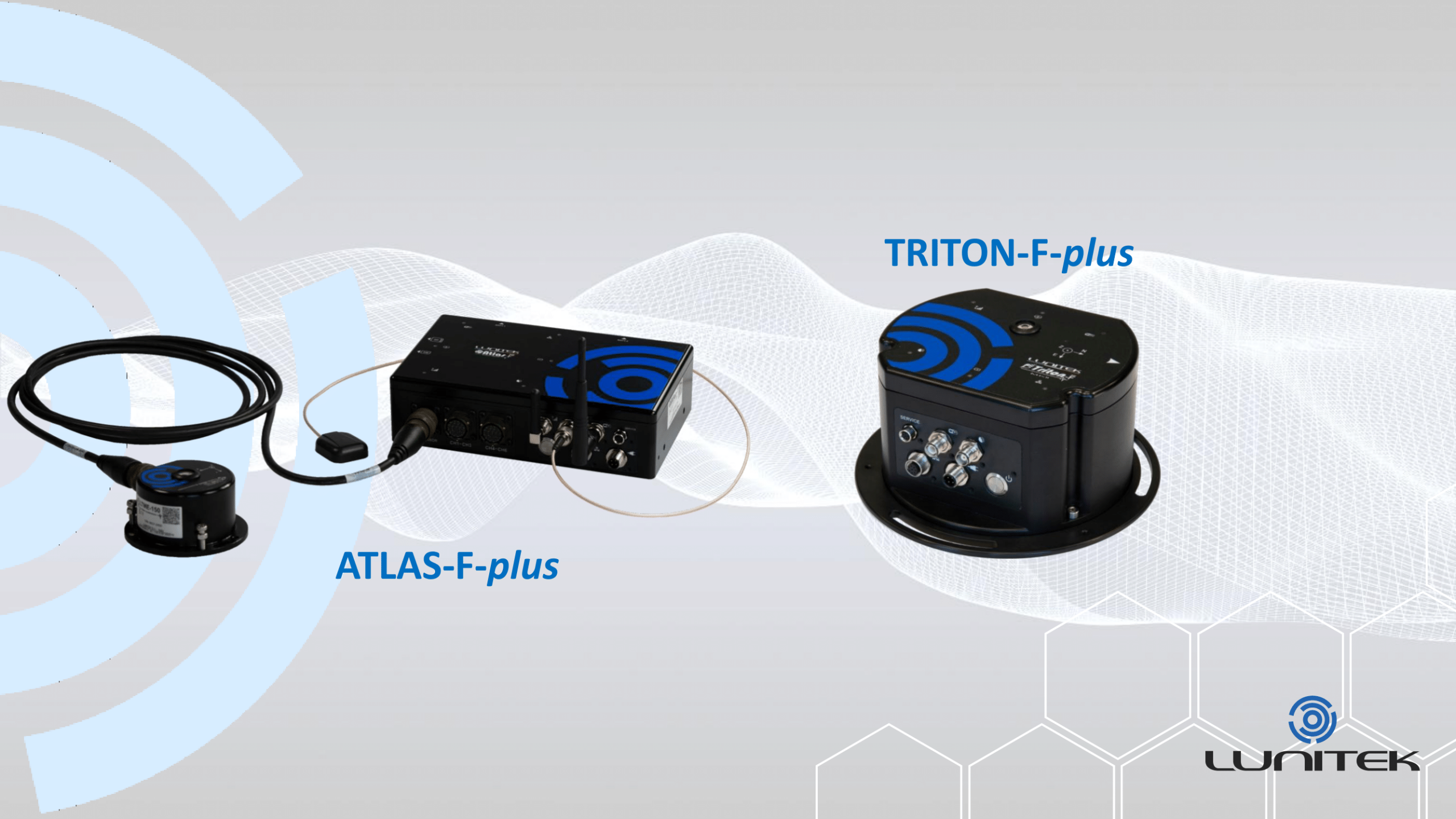
In 2025 we have released a major upgrade of our two flagship product lines – ATLAS and Triton.
- ATLAS includes our digital recorders
- Triton is our top all-in one device for seismic and structural monitoring
With the –plus generation, both lines have received a significant boost in computational power, enabling low-latency performance and supporting high-demand software applications.
Triton-F-plus – Extended Sensor Support
Triton-F-plus currently supports accelerometric sensors ranging from MEMS (90 or 110 dB) to Force Balance (up to 160 dB).
In 2026, we will introduce Triton-F-plus seismograph, which will support geophones and short-period velocimeters (1s–10s).
Key Hardware Upgrades
- 32-bit ADC with dynamic range > 145 dB @ 100 sps
- Gigabit Ethernet connection for faster data transfer
- Removable batteries – allowing safe and convenient air transport
- NEWLTE Module – upgraded the cellular communication module to support 4G/5G
- NEWPTP (Precision Time Protocol) for sub-microsecond clock synchronization across devices over Ethernet
Smart Control and Remote Management
All our devices can be remotely controlled via web interface, allowing you to:
- Start or stop recordings
- View real-time data streams
- Download recordings and manage configurations
Through our JUPITER web interface, you can also:
- Monitor the health of your device network
- Collect and review trigger events
- Manage multiple instruments in batch mode
Get your data processed – Iuno Analysis
We’ve developed Iuno Analysis, a desktop-based tool for offline data processing. After uploading your files in MiniSeed and ASCII formats, you’ll be able to perform:
- Data comparisons
- FFT, PSD, and PPSD analyses
- H/V spectral ratio calculations
- Building damage estimations (following the DIN 4150-3:2016 regulation)
- Response spectra generation
